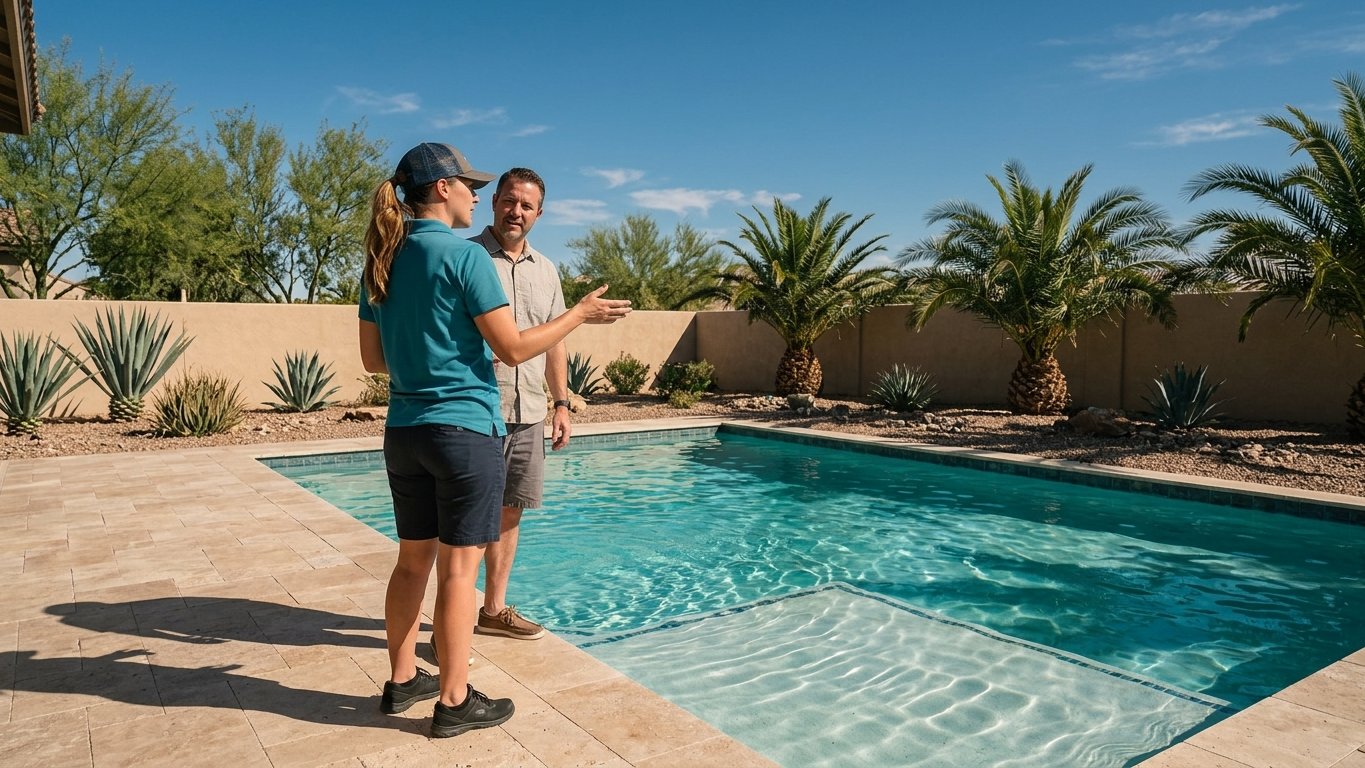
The price of pool service in Las Vegas depends on a handful of specific factors — pool size, your equipment, whether chemicals are included, and whether you need routine weekly care or a one-time recovery — so there is no single number that fits every backyard. Any company that quotes a flat figure sight unseen is guessing. The honest answer is that price is built from the pool in front of you, and the desert climate raises the floor on what good service actually costs.
Pool Size and Equipment Set the Baseline
The single biggest driver of price is the size of the body of water. A small, simple pool takes less time to brush, vacuum, and balance than a large pool, and it needs less chemical to hold a stable chlorine level. A bigger pool is not just more square footage of surface — it is more gallons to sanitize, more wall to brush, and more water for the desert sun to work against. When you add a spa, a tanning ledge, or a large footprint, the time per visit climbs, and time is most of what you are paying for.
So the baseline question a company is really answering is simple: how much pool is there to take care of? Everything else adjusts up or down from that starting point.
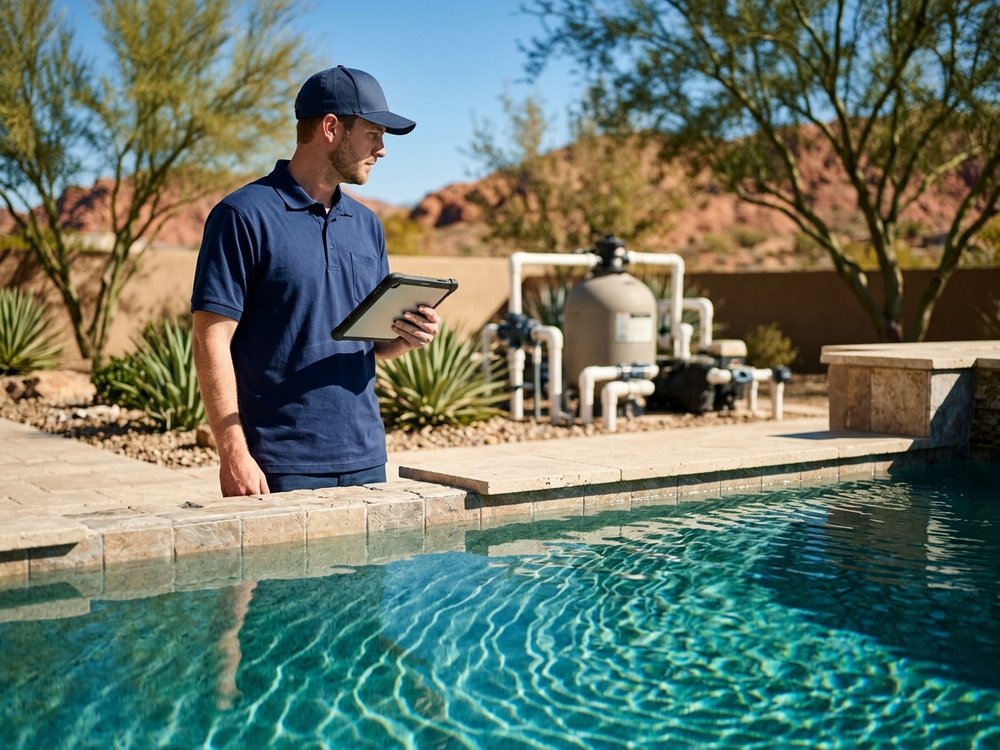
Two pools of the same size can also land at different prices because of what is attached to them. A pool with a spa, a waterfall, a sheer-descent water feature, or an attached heater has more to inspect and maintain every visit. Automatic cleaners, salt systems, and variable-speed pumps all change the routine. More equipment means more points to check, more components that can drift out of spec, and more that a thorough tech has to keep an eye on.
Features are part of why two neighbors can pay different rates for what looks like the same service. The pool with three water features and a spa simply has more going on than the plain rectangle next door, and the price reflects that added attention.
Chemicals Included Versus Billed Separately
One of the biggest sources of confusion in pricing is how chemicals are handled. Some plans roll chemicals into a single flat rate, so your price stays the same month to month even when the chemistry swings. Other plans charge for labor and bill chemicals separately, which can look cheaper on paper but rises in summer when chlorine demand is at its peak.
Neither model is automatically the better deal — what matters is comparing quotes on the same terms. If one company includes chemicals and another does not, the two headline prices are not measuring the same thing. Ask directly so you are comparing a full-service number to a full-service number, not a labor-only rate to an all-in rate.
Weekly Service Versus One-Time Jobs
Routine weekly service is priced as an ongoing flat rate, while one-time work is quoted as its own job. A single cleaning, an equipment repair, a filter deep-clean, or a green pool recovery are each scoped individually because the labor and materials are different from a standard visit. A one-time cleanup of a neglected pool costs more per visit than a maintained pool on a schedule, simply because there is more to undo.
This is also why stretching out service to save money often backfires. The routine of consistent care is the cheaper path; the expensive jobs are the ones that come from letting a pool fall behind. A pool kept on a steady rhythm rarely needs the costly interventions.
Green Recovery Is Its Own Category
Recovering a green pool is the clearest example of a price that has nothing to do with routine service. A green-to-clean is labor-heavy, uses a large amount of chemical, and usually takes several visits while the filter processes dead algae out of the water. A light green pool is a smaller job; a dark, swampy one is a much bigger one, because the deeper the bloom, the longer the recovery and the more the equipment has to work.
The takeaway is that prevention is far cheaper than recovery. The cost of a green pool cleanup almost always exceeds what consistent maintenance would have cost over the same stretch, which is exactly why staying on a schedule pays for itself.
Why Desert Pools Cost What They Do
Las Vegas pools are genuinely more demanding to maintain than pools in mild climates, and that shapes pricing. The intense summer UV burns off chlorine faster than almost anywhere in the country, so a desert pool needs more sanitizer and tighter chemistry to stay clear. Evaporation pulls inches of water out every week, concentrating minerals and dropping the water line. The valley’s hard tap water constantly adds calcium that has to be managed before it scales onto tile and equipment. Dust storms drop debris and algae-feeding material into the water with no warning.
None of these are optional problems a company can skip. They are the daily reality of keeping water clear in the Mojave, and they are baked into the cost of doing the job right. A price that looks suspiciously low usually means corners are being cut somewhere — fewer chemicals, faster visits, or skipped steps — and in this climate those shortcuts show up fast as cloudy or green water.
Access, Condition, and Other Quiet Factors
A few less obvious things can nudge a quote up or down. How easy the pool is to reach matters — a straightforward gate is simpler than a property where the tech has to navigate locked access, steep steps, or a long walk to the equipment pad. The starting condition counts too: bringing a neglected, debris-filled pool up to a maintainable baseline is more work than picking up a pool that has been cared for, which is why the first visit on a previously ignored pool sometimes carries a one-time cleanup on top of the routine rate.
Surroundings play a role as well. A pool ringed by trees or heavy landscaping drops more debris into the water than one in an open yard, which means more skimming and more frequent basket and filter attention. None of these are surcharges in a punitive sense — they are just honest reflections of how much labor a given pool actually takes. A company that looks at the pool before quoting is accounting for all of it, which is exactly why an in-person look produces a more accurate number than a phone estimate.
Getting an Honest Quote
The most reliable way to know your price is to have someone look at the pool, count the equipment, and quote a flat monthly rate against what they see. A good company will tell you whether chemicals are included, explain what each visit covers, and keep the rate predictable even as the seasons push the chemistry around. If you want a dependable, flat-rate routine that keeps a desert pool from swinging green, our weekly pool cleaning service in Las Vegas is built around exactly these realities.
Call or text us for a straightforward quote after a quick look at your pool.
AUTHORITY LINK TODO: add one verified outbound source (see references/authority-domains.md) that supports a specific claim in this article, in-paragraph, then set authorityVerified: true.