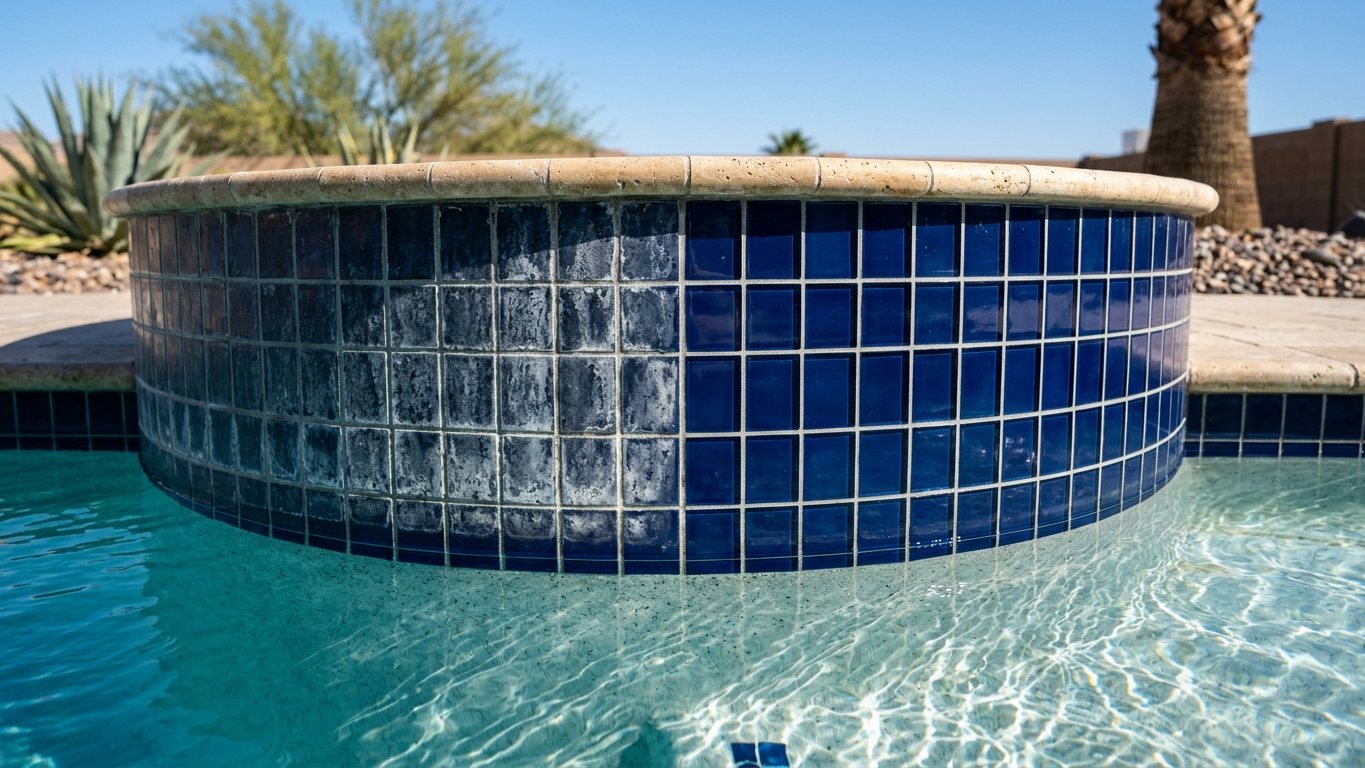
If your waterline tile has gone from clean glass to a chalky white or gray band, you are seeing calcium scale — and in Las Vegas it is one of the most common pool problems there is. The valley’s very hard tap water leaves minerals behind every time the surface evaporates, and the desert sun makes that happen relentlessly. Left alone, the buildup gets thicker, rougher, and harder to remove. Pool tile cleaning is one of the detail services we pair with our weekly Las Vegas pool cleaning to keep a backyard looking its best.
Why Las Vegas tile scales so fast
Calcium scale forms where the water meets the air, and the desert stacks every factor against your tile. The local tap water is heavy with dissolved minerals, so every gallon that tops off the pool brings more calcium with it. Then the heat takes over: through a Las Vegas summer the pool can lose several inches of water a week to evaporation, and as that water leaves, the minerals it carried stay behind and crystallize onto the glass and grout right at the water line. The same evaporation that drops your water level is what cements that white band onto the tile faster here than in almost any other climate.
The two kinds of calcium we deal with
Not all buildup is the same, and that changes how we remove it. Calcium carbonate is the more common, softer scale — it looks chalky white, and it will often fizz if a little acid touches it. It tends to respond to gentler methods. Calcium silicate is the tougher one: grayish, dense, and slow to form, which means by the time you see it, it has usually been building for a while. Silicate scale almost always needs a more aggressive mechanical approach. Identifying which type is on your tile is the first thing we do, because using the wrong method either fails to touch the scale or risks the finish.
How we get it off
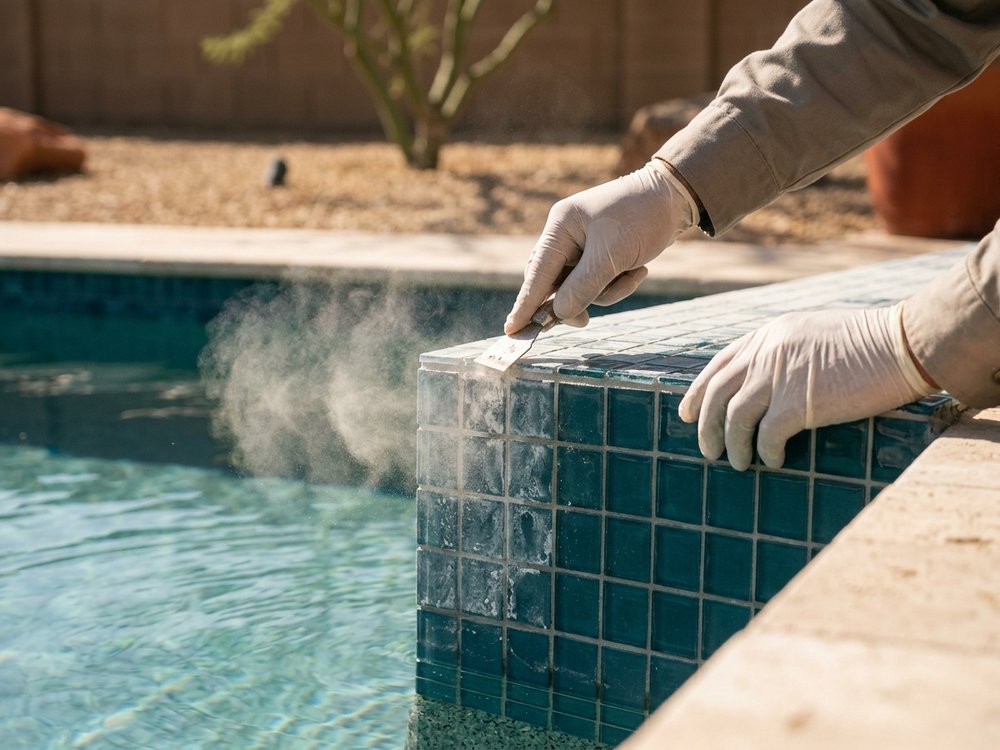
For lighter carbonate scale, we often start with hand work — a pumice stone worked carefully along the tile, or a calcium-release product that loosens the deposit so it can be scrubbed away. This is slower and gentler and is a good fit when the buildup is thin. For heavier deposits, or for silicate scale that will not budge, we use bead blasting: fine glass beads or a similar media fired at the tile under controlled low pressure. The media chips the calcium off without scratching or etching the glaze underneath. We always test a hidden spot first and adjust before we work across the visible waterline, so the tile comes out clean rather than dulled.
What your tile looks like afterward
Done right, the waterline goes back to the glass, stone, or porcelain you actually paid for — the color and shine return, and the rough crust is gone. Beyond looks, removing scale matters because a thick calcium band traps grime, can harbor algae in its rough texture, and only gets harder to remove the longer it sits. Clearing it resets the tile to a clean baseline. We will also point out anything we notice while we are down at the water line, like loose tile or failing grout, so you know about it early rather than after a piece pops off.
Keeping the buildup from coming back
In a desert valley with very hard water, some calcium return is simply part of owning a pool — but you can slow it dramatically. Keeping calcium hardness and pH balanced reduces how aggressively minerals drop out of the water, and keeping the pool topped off so the water line is not parked in one spot for months helps too. For pools that scale quickly, a periodic tile touch-up is far easier than waiting for a heavy crust to rebuild. We are happy to recommend a sensible interval and fold it into regular service if that is the simplest path for you.
Tired of looking at a white ring around your pool? Call or text and we’ll take a look and quote the tile cleaning.
SERVICE VERIFY: confirm Las Vegas Pool Cleaner offers this exact service (and any equipment/credential it requires) before launch.
AUTHORITY LINK TODO: add one verified outbound source (see references/authority-domains.md) that supports a specific claim on this page, in-paragraph, then set authorityVerified: true.