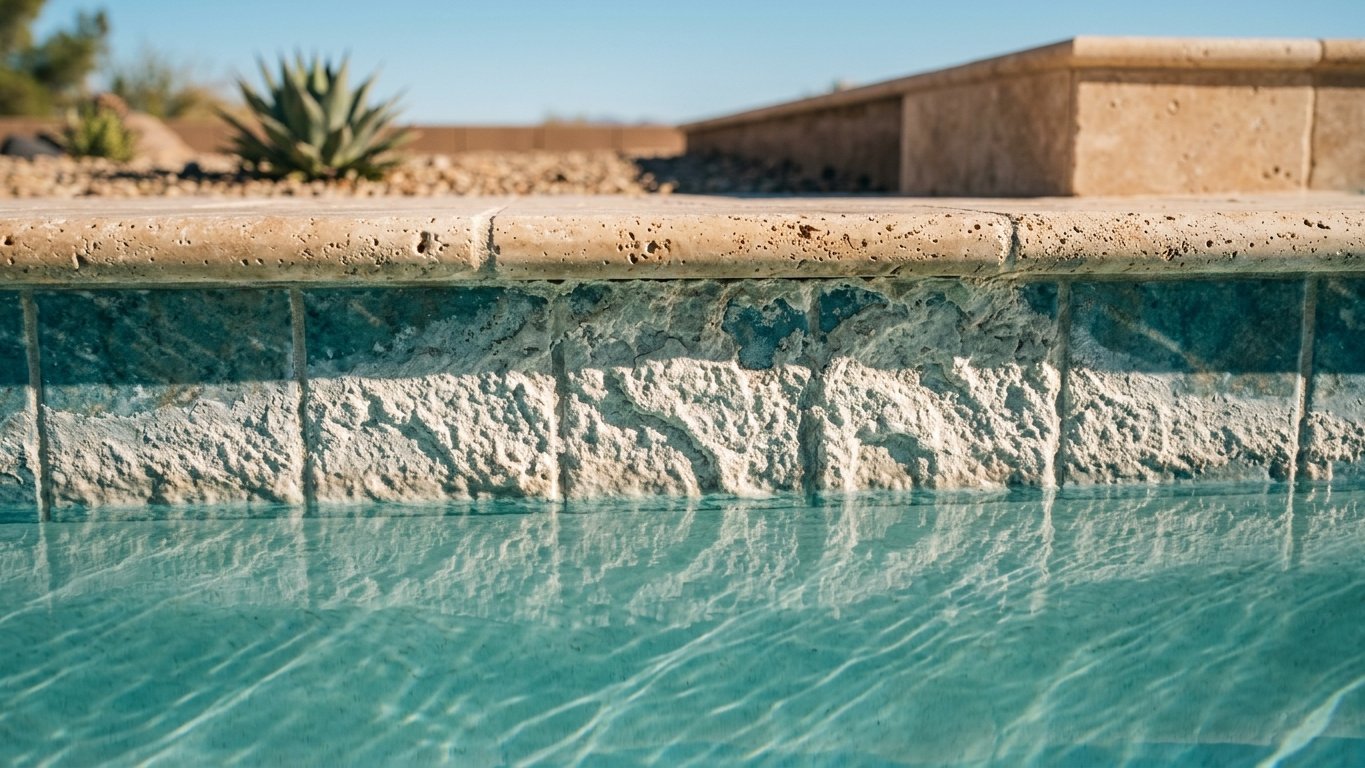
Las Vegas pools get heavy calcium buildup because the valley combines two things that almost guarantee it: hard tap water loaded with minerals, and a desert climate that evaporates pool water relentlessly while leaving those minerals behind. Every time water evaporates and you refill, the calcium concentration climbs, and the excess hardens onto your waterline tile as the white, crusty scale most owners spot first. It is one of the most common pool problems in the Mojave, and it is driven by basic chemistry, not neglect.
Hard Water Is the Starting Point
The water that fills your pool already carries a significant mineral load before it ever reaches the tile. Hard water simply means water with a high concentration of dissolved minerals, calcium chief among them, and the Las Vegas valley is known for it. That mineral content does not disappear once the water is in the pool — it stays dissolved, waiting for conditions that pull it out of solution and deposit it on a surface.
So the calcium that ends up crusted on your tile did not come from nowhere. It rode in with the fill water, which means a desert pool starts the scaling process from a higher baseline than a pool filled with soft water would.
Evaporation Concentrates the Minerals
Hard fill water alone would scale slowly. What accelerates it in Las Vegas is evaporation. The desert heat and dry air pull a meaningful amount of water out of an open pool every week, and here is the key: water evaporates, but minerals do not. The calcium that was dissolved in the water that left stays behind in the water that remains.
As that cycle repeats through a long, hot season — water evaporates, you top off with more hard water, more water evaporates — the calcium concentration in the pool steadily climbs. The pool is effectively being slowly concentrated, like a pot left simmering on a stove. Eventually the water holds more calcium than it can keep dissolved, and the excess comes out of solution and sticks to the nearest surface, which is usually the tile right at the waterline.
Scale Is Different From a Stain
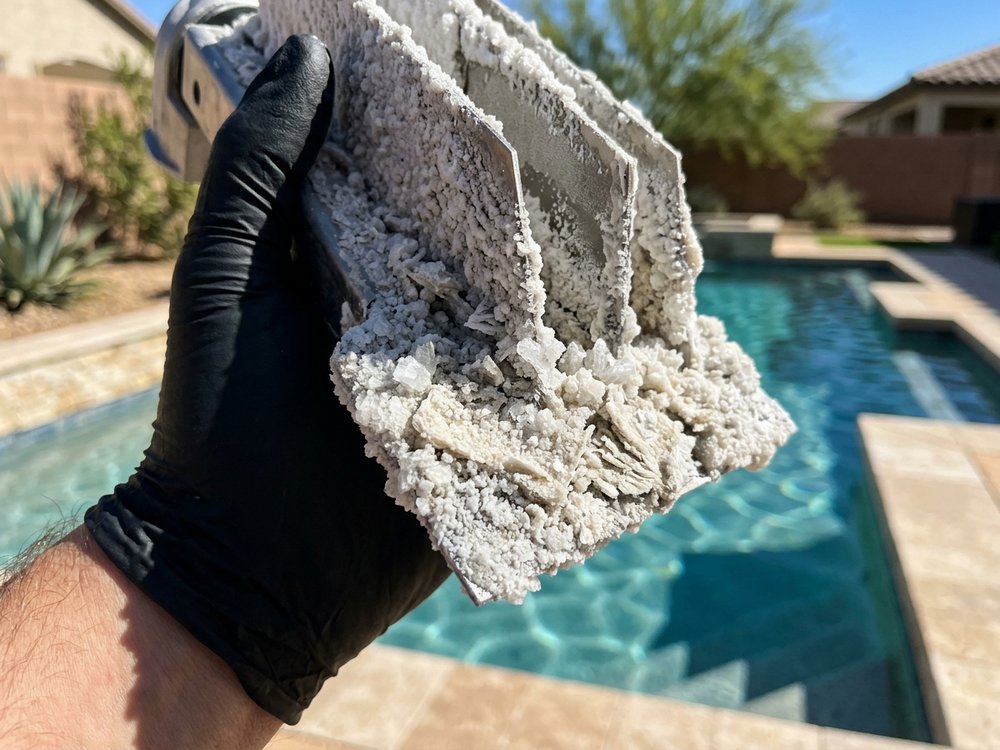
When owners see white or gray deposits on their tile, they often call it a stain, but calcium scale and a stain are two different problems that need two different fixes. Scale is a raised, physical deposit — you can run a finger across it and feel the rough, crusty texture sitting on top of the tile. A stain, by contrast, is a discoloration that has soaked into or under the surface and feels smooth.
The distinction is not academic. Scale has to be physically removed because it is a hardened mineral layer, while a stain is treated chemically because it is a color change rather than a deposit. Trying to scrub off a stain or pour chemicals on hardened scale wastes effort and can damage the tile or surface. Correctly identifying which one you are looking at is the first real step toward fixing it.
Why It Shows Up at the Waterline First
Calcium scale almost always appears first as a band along the waterline, and that is no coincidence. The waterline is where evaporation does its most concentrated work — the surface of the water is constantly exchanging with the dry air, and as it rises and falls with evaporation and refilling, it leaves mineral deposits right at that boundary. Splashing and the constant wetting and drying at that exact line build the deposit up faster there than anywhere else.
That is why the telltale sign of a desert hard-water pool is the chalky ring at the top of the water, often most visible on glass or stone tile. Left alone, the band thickens, spreads, and becomes progressively harder to remove the longer it cures.
Prevention Through Balance
You cannot turn off the desert, but you can slow scaling dramatically by keeping the water chemistry in balance. The relationship between calcium hardness, pH, and total alkalinity determines whether the water tends to deposit scale, stay neutral, or dissolve surfaces. When those values drift high, the water becomes prone to dropping calcium onto everything it touches; kept in their target ranges, the water holds its minerals in solution far better.
Practical prevention also means keeping the pool topped up so minerals stay diluted rather than concentrating, and wiping the waterline regularly so any deposit is removed while it is still soft and thin. None of this stops scale entirely in a hard-water desert, but consistent balancing is the single most effective thing that keeps it from racing ahead. This is one of the reasons regular service matters so much here — steady chemistry is preventive maintenance for your tile and equipment, not just your water clarity.
Scale Does More Than Look Bad
It is easy to write calcium buildup off as a cosmetic nuisance, but left unchecked it does real damage beyond the unsightly ring. Scale does not stay politely on the tile — the same mineral deposition coats the inside of plumbing, builds up in the filter, and crusts onto heater components, where it restricts flow and makes equipment work harder. A heater fighting through a layer of scale runs less efficiently and wears out sooner, and a salt system’s cell can foul with the same deposits.
Inside the pool, scale roughens smooth surfaces and gives algae and debris more texture to cling to, which can make routine cleaning marginally harder over time. None of this happens overnight, but it is the reason calcium control is treated as protective maintenance rather than mere appearance. Managing the water chemistry before scale forms protects the expensive parts of the pool, not just the look of the waterline — which is one more argument for staying ahead of it rather than waiting until the deposits are thick and the equipment is already straining.
Removing Scale That Has Already Formed
Once scale has hardened, balancing the water will not lift it — it has to be removed. Light, fresh deposits can sometimes be addressed before they cure, but established scale, especially on glass, stone, or tile, calls for proper removal methods that take the mineral layer off without scratching or etching the surface underneath. The right approach depends on the tile material and how thick and cured the deposit is, which is why this is work best matched to the surface rather than attacked with whatever is on hand.
Done correctly, the tile comes back to a clean, bright waterline; done carelessly, the surface can be permanently marked. If you have a chalky band you cannot wipe away, our professional pool tile and calcium cleaning removes built-up scale safely and restores the waterline.
Call or text us to have your tile assessed and your calcium buildup cleared.
AUTHORITY LINK TODO: add one verified outbound source (see references/authority-domains.md) that supports a specific claim in this article, in-paragraph, then set authorityVerified: true.