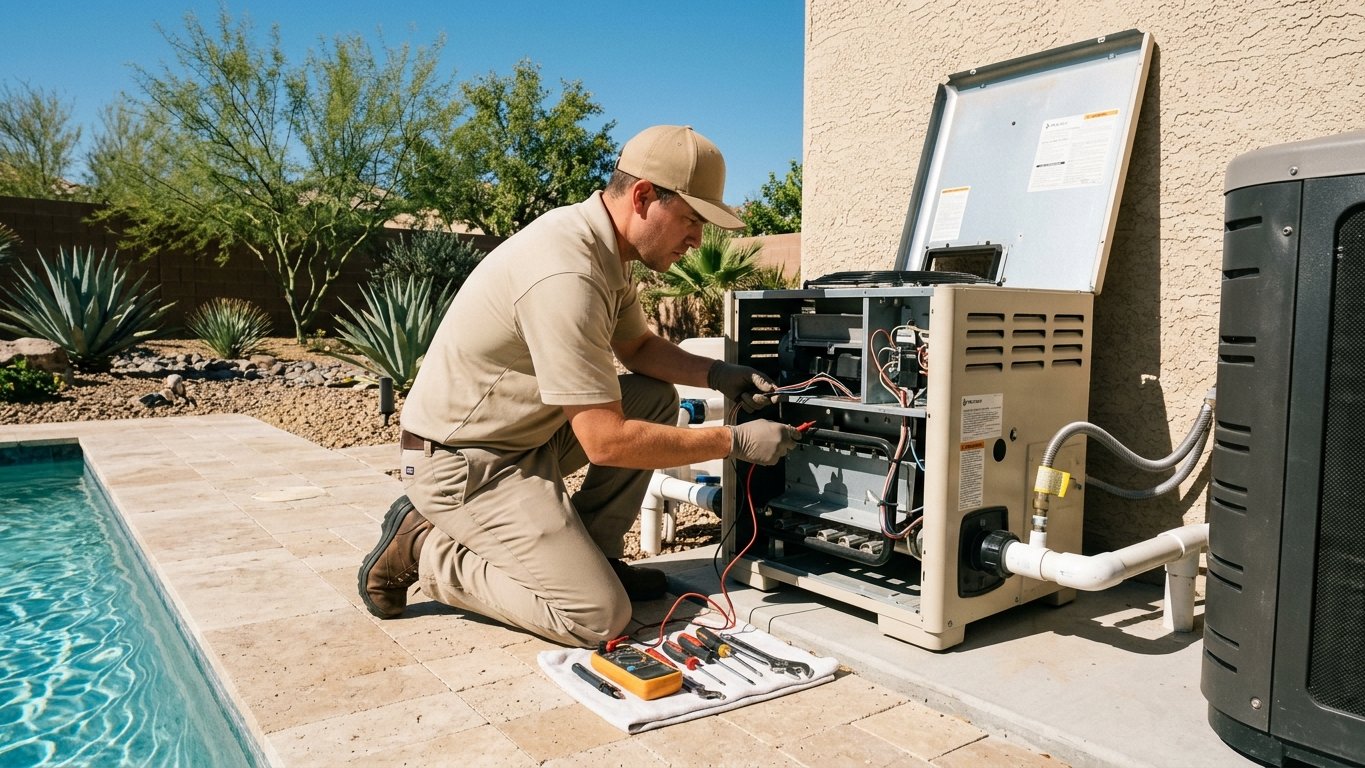
Las Vegas pools get real use in the spring and fall, when daytime weather is perfect but the water still needs a few degrees of help — and that is exactly when a failing heater ruins the season. A heater that won’t ignite, fires and then quits, or never reaches temperature turns a usable pool into a cold one. Our heater work covers both gas and heat-pump units and is part of our full range of Las Vegas pool repair services.
Common heater symptoms and causes
Heater problems tend to announce themselves clearly. A heater that won’t fire at all often has a failed ignitor, a tripped pressure switch, or a gas-supply issue. One that ignites and then shuts down within minutes is usually a dirty flame sensor losing the flame signal, low water flow, or an overheating exchanger. A heater that runs but never warms the pool may have a partially scaled exchanger or an undersized run schedule. And error codes on the control board point us toward the specific fault. We read the symptoms and the diagnostics together instead of throwing parts at it.
What makes heaters worth a careful diagnosis is that they are built to protect themselves, so most failures are really the heater refusing to run rather than the heater being broken. A pool heater is a chain of safety switches — pressure switches that confirm water is flowing, high-limit switches that watch temperature, sensors that verify the flame actually lit — and if any link in that chain is unhappy, the heater shuts down and may flash a code. That is a feature, not a fault: it keeps the unit from running dry or overheating. But it also means the displayed problem and the underlying cause are often different things, and resetting the heater without addressing why a switch tripped just sends you back to a cold pool an hour later. We trace the chain to the actual trigger.
Gas heater repairs
Gas heaters have the most moving parts, and they fail on a predictable set of them. Ignitors burn out. Flame sensors get dirty and stop confirming the flame. Gas valves stick or fail. Pressure switches and high-limit switches trip when flow or temperature is off. And — very commonly in Las Vegas — the heat exchanger scales up from hard water and starts overheating. We diagnose and repair the full chain, from the gas valve and burners through the sensors and safety switches, and we check water flow and chemistry as part of the picture, because a “heater” problem is sometimes really a flow or scale problem.
Heat-pump heater repairs
Heat pumps work entirely differently, pulling warmth from the air rather than burning gas, so they fail on a different set of parts. We troubleshoot fan motors and capacitors, compressors, contactors, and the coil and refrigerant side when a unit runs but won’t produce heat. Las Vegas heat pumps also collect dust and debris on their coils, which hurts efficiency and can cause the unit to struggle. Whichever system you have, we identify it correctly and apply the right diagnostic path, rather than treating every heater the same.
Hard water and the heat exchanger
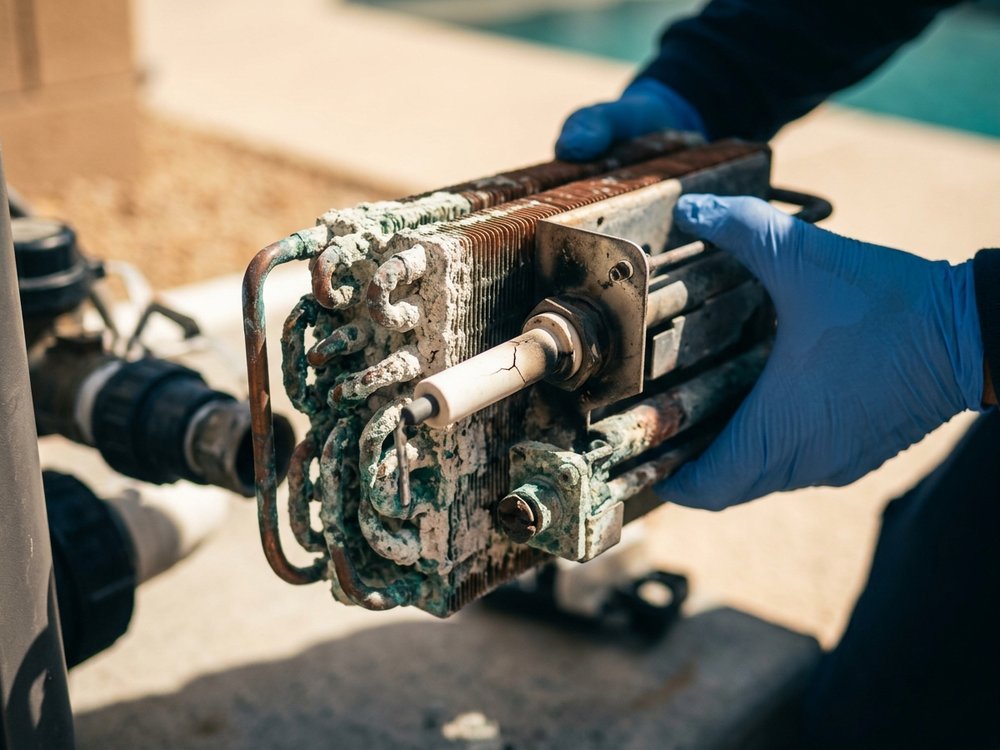
The single most common heater problem we see in the valley traces back to water chemistry. Las Vegas tap water is high in calcium, and when that water heats inside the exchanger, the calcium precipitates out and coats the tubes with scale. Scale acts as insulation, so the exchanger transfers heat poorly, the heater runs hotter and longer to compensate, and the safety circuit eventually starts short-cycling the unit. Left alone, scale can corrode the exchanger past the point of repair. We address the scale, look at why the water is unbalanced, and on a heavily scaled older heater give you a frank assessment of whether the repair is worth it.
The reason scale is so destructive in a heater specifically is that heat drives the process. Calcium comes out of solution faster as water temperature rises, and the hottest surface in your entire pool system is the inside of the heat exchanger — so the exchanger is exactly where the valley’s hard water most wants to deposit. It becomes a feedback loop: scale insulates the tubes, the heater runs hotter to push heat through the buildup, and the extra heat lays down even more scale. That is why heater problems here are so often a chemistry problem in disguise, and why simply replacing a part without correcting the water balance tends to bring the same failure back. Keeping calcium hardness in range and the water properly balanced is the single best thing an owner can do to protect a heater in this climate.
Spring and fall: the seasons that matter here
Heater timing in Las Vegas is its own consideration, because the heater earns its keep in narrow windows. Through the deep summer the pool is often warm enough on its own — sometimes too warm — so the heater sits idle for months. The real demand comes in spring and fall, when the air is beautiful but the water still needs a few degrees to be comfortable, and that is precisely when a heater that has been dormant all summer gets called on and reveals a fault. We see a wave of heater calls as those seasons turn, which is why catching a marginal ignitor or a scaling exchanger before the shoulder season — rather than the morning you finally want to swim — keeps you from losing the very weeks the heater exists for. A quick pre-season check is far cheaper than an emergency repair during a perfect October week.
Repair-versus-replace on an aging heater
Heaters are among the more expensive pieces of pool equipment, so the repair-or-replace decision matters. A newer heater with a bad ignitor, flame sensor, or gas valve is clearly worth fixing. But the heat exchanger is the costliest component, and on an older, corroded unit, replacing it can approach the price of a new heater — at which point a replacement often makes more sense. We give you the real repair cost, an honest read on the heater’s remaining life, and the replacement option, so you are not pouring money into a unit on its way out.
If your pool heater won’t fire, won’t hold temperature, or keeps shutting off, call or text us and we will diagnose the real cause before the season slips away.
SERVICE VERIFY: confirm Las Vegas Pool Cleaner offers this exact service (and any equipment/credential it requires) before launch.
AUTHORITY LINK TODO: add one verified outbound source (see references/authority-domains.md) that supports a specific claim on this page, in-paragraph, then set authorityVerified: true.