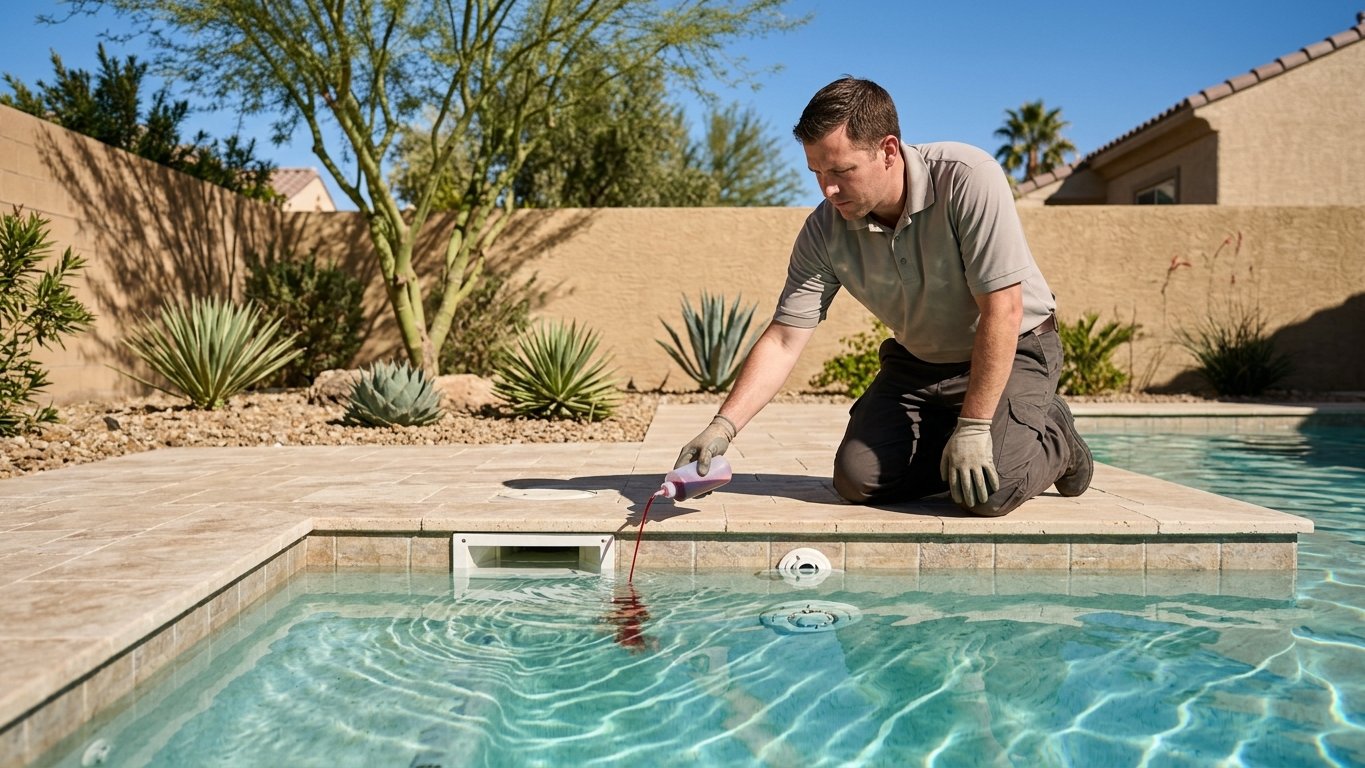
A pool that keeps dropping is more than an annoyance in Southern Nevada — water is scarce and expensive here, so a leak quietly wastes a limited resource and runs up your bill every single day. The challenge is that our desert climate also evaporates a lot of water naturally, so the first job is always telling a real leak apart from normal evaporation. Our leak work is methodical, and it is one of the other pool equipment repairs we handle across the Valley.
Evaporation versus a real leak
Before chasing a leak, we confirm there is one. In a Las Vegas summer, a pool can lose a quarter to half an inch a day to evaporation alone, so a dropping water line is not automatically a problem. The bucket test settles it: we float a bucket of pool water on a step so it evaporates at the same rate as the pool, then compare the two over a day or two. If the pool drops noticeably more than the bucket, the difference is a leak. This simple step keeps us from tearing into a pool that is only doing what every desert pool does in July.
The bucket test works because it cancels out the weather. Both the bucket and the pool sit in the same sun, the same dry desert air, and the same wind, so they evaporate at the same rate — whatever the pool loses beyond the bucket has to be going somewhere other than the sky. That distinction matters more here than almost anywhere, because our evaporation is so aggressive that owners routinely assume a real leak is “just the heat,” or panic over normal summer loss that is entirely evaporation. Running the test first replaces a guess with a number. It also tells us roughly how big the leak is, which helps set expectations before we start narrowing down where it is hiding.
How we narrow down the source
Once a leak is confirmed, we locate it from simplest to most involved rather than guessing. Comparing water loss with the pump running versus off is the key early clue: faster loss with the equipment on points to the pressure-side return plumbing, faster loss with it off points to the suction side or the shell, and loss at a steady rate regardless points toward the structure. That on-versus-off behavior tells us where to focus before we touch anything, so we are not pressure-testing every line or inspecting every fitting when the symptoms already point one direction.
Pressure testing and structural leaks
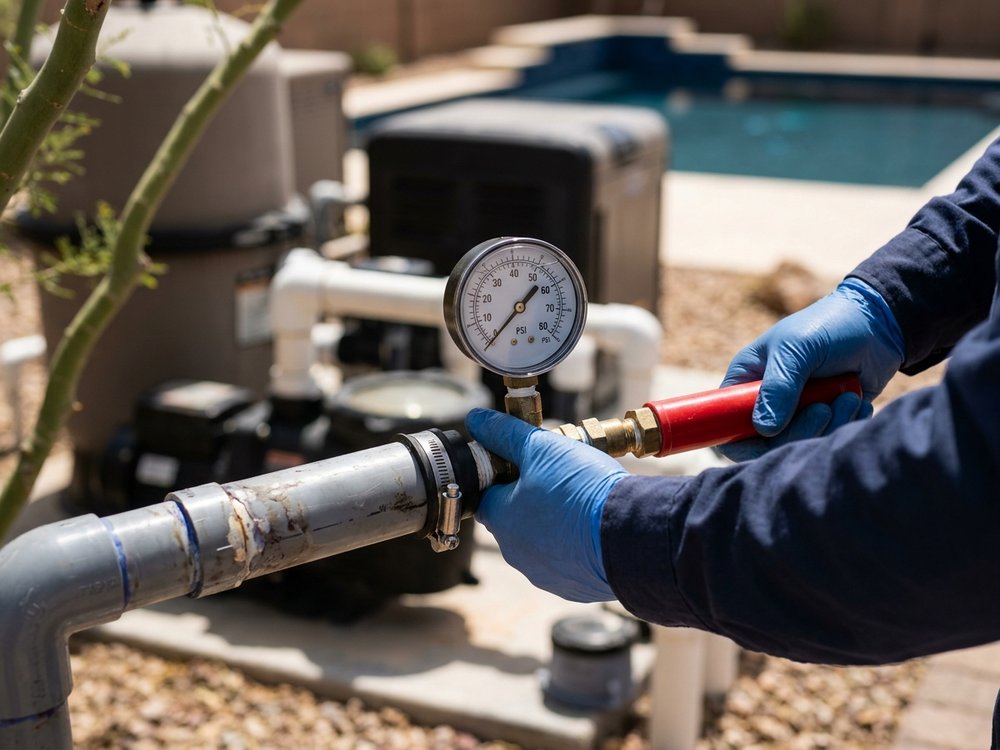
From there we test the specific systems. We pressure-test the plumbing lines to find underground leaks that are otherwise invisible, isolating each line to confirm whether it holds. We inspect the skimmers, which commonly crack where the plastic body meets the concrete, and the light niches, which leak around the conduit and seals. We check fittings, returns, and the main drain, and we examine the shell and plaster for cracks. Each likely source gets checked deliberately based on what the earlier tests indicated, so the diagnosis is targeted instead of a deck-destroying fishing expedition.
Plumbing leaks deserve special mention because they are the ones owners can never see for themselves. The lines that carry water to and from the pool run underground, often beneath the deck, so a pipe weeping into the surrounding soil shows up only as a steadily dropping pool — no puddle, no obvious clue. Pressure testing is how we make those invisible leaks visible: we isolate a line, pressurize it, and watch whether it holds or bleeds off, which confirms not just that a line leaks but which one. That precision is what lets a plumbing repair be surgical. Finding the exact line and spot means we can access just that section rather than guessing and opening up a deck hoping to get lucky, which protects both your hardscape and your wallet.
Why leaks cost more here
A leak in Las Vegas carries a bigger penalty than the same leak almost anywhere else. Water is a genuinely scarce resource in Southern Nevada, and even a modest leak losing an inch or two a day adds up to thousands of gallons a month in our climate — wasted water and a higher bill. There are knock-on costs too: a leak constantly dilutes your chemicals, making the pool harder and more expensive to keep balanced, and water escaping into the ground can undermine decking and erode soil around the pool. Finding and fixing a leak promptly protects the resource, your wallet, and the structure around the pool.
Catching leaks early in the desert
The cost of a pool leak in Las Vegas scales with how long it runs, which makes early detection its own form of savings. A small leak that loses an extra inch a day does not look dramatic, but in our climate it quietly pours thousands of gallons a month into the ground while inflating your water bill and diluting the chemicals you keep adding. Left for a season, water working into the soil can also undermine decking and shift the ground around the pool, turning a modest plumbing or seal repair into a structural one. The practical takeaway is to act on the signs early: a fill valve running far more than it used to, a water line that keeps dropping faster than evaporation explains, or chemistry that never seems to hold. Each is worth a bucket test before it grows.
What to expect from leak service
We start with the bucket test to verify the loss is a real leak, then use the pump on-versus-off comparison to narrow the location before any invasive work. We pressure-test plumbing and inspect skimmers, niches, fittings, and the shell as the symptoms direct, and we explain what we find and what the repair involves. Some fixes — a skimmer seal, a fitting, a niche — are straightforward; an underground plumbing or structural leak is a larger job, and we will tell you the realistic scope and timeline up front rather than after we have started digging.
If your pool keeps dropping and you are not sure whether it is a leak or just the heat, call or text us and we will run the bucket test and track down the truth.
SERVICE VERIFY: confirm Las Vegas Pool Cleaner offers this exact service (and any equipment/credential it requires) before launch.
AUTHORITY LINK TODO: add one verified outbound source (see references/authority-domains.md) that supports a specific claim on this page, in-paragraph, then set authorityVerified: true.