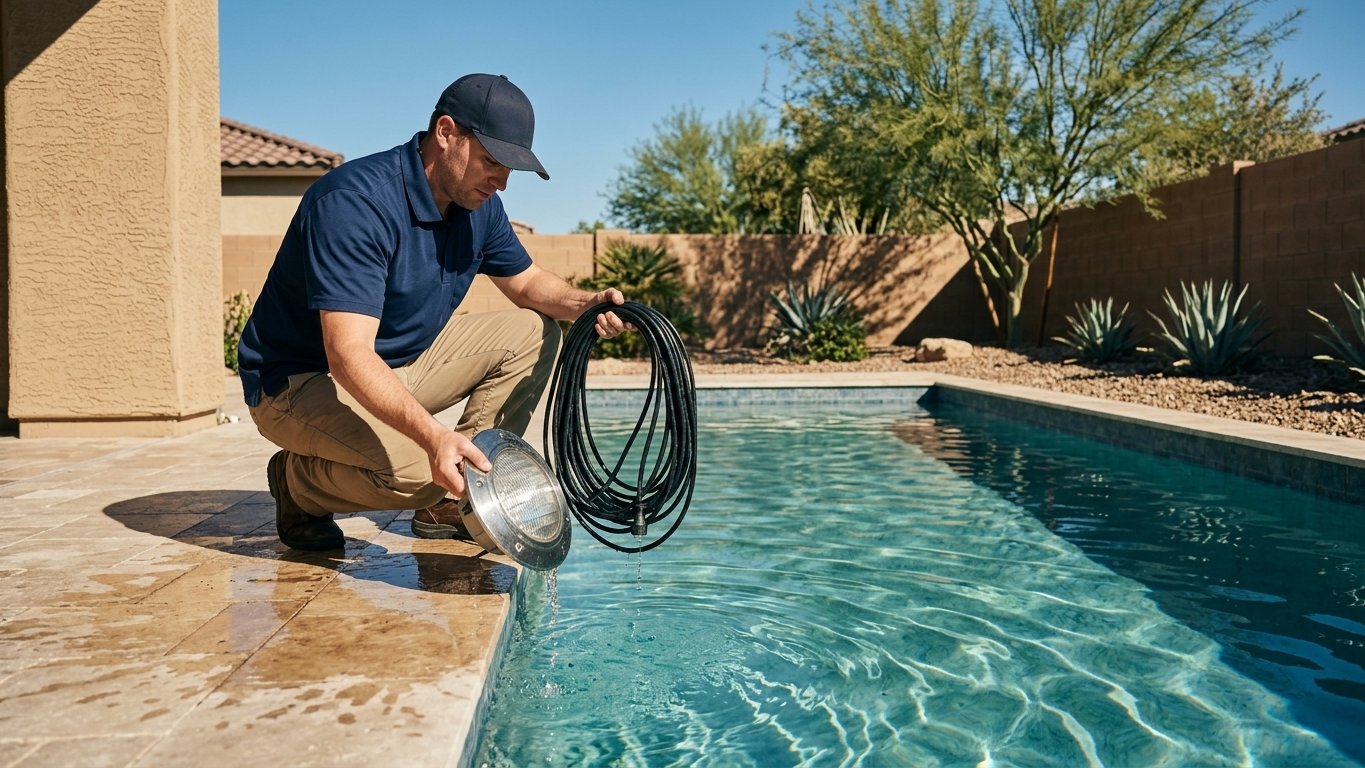
A dead pool light takes the backyard offline at night — and in Las Vegas, where warm evenings stretch across much of the year, that is a lot of lost use. Pool lights also sit at the intersection of water and electricity, so a flickering or tripping light is not just an inconvenience; it can signal a safety issue worth addressing promptly. Our light work covers repairs, LED upgrades, and the electrical and sealing details, and it is part of pool repair across the Las Vegas Valley.
Why your pool light went dark
A pool light that has stopped working usually comes down to a short list. The simplest is a burned-out bulb or a failed LED fixture at the end of its life. Next is a tripped GFCI breaker, which sometimes just needs a single reset — but if it trips again, that is a signal, not a nuisance. Beyond that, corroded wiring or connections, a deteriorating fixture, or water that has intruded into the housing can all kill the light. We test the GFCI, the circuit, and the fixture itself to identify which it is, rather than swapping a bulb and hoping the real problem goes away.
The order we check those in matters, because the easy explanations and the serious ones look identical from the deck — the light is simply off. A bulb at the end of its life and water seeping into the housing both leave you in the dark, but one is a five-minute swap and the other is a safety issue that needs the circuit shut down and investigated. That is why we do not start by assuming the cheapest cause. We confirm whether the GFCI has tripped and why, verify the circuit is carrying power correctly, and inspect the fixture and its seal before we decide what the light needs. A dark light is a question, not a diagnosis, and answering it properly is what keeps a simple repair from masking a real fault.
LED upgrades for night use
When an older incandescent fixture fails, replacing it with LED is usually the smarter move rather than putting another short-lived bulb in. LEDs draw far less power, last dramatically longer, and run cooler, and color-changing models let you set lighting scenes for the pool. Because Las Vegas delivers warm nights across much of the year, pool lights here earn real use, so the energy savings and longevity of an LED add up faster than they would in a climate where the pool sits dark half the year. We will price a straight bulb replacement next to an LED upgrade so you can weigh the up-front cost against the long-term savings.
GFCI, wiring, and electrical safety
Pool lights combine water and electricity, which is why they are required to be grounded and protected by a working ground-fault circuit interrupter. A light that repeatedly trips the GFCI is often warning you that water has reached the wiring or there is a fault in the circuit — exactly the condition the GFCI exists to catch — and the wrong response is to keep resetting it. We test the GFCI and the circuit, check the bonding and grounding, and find the actual fault. We treat the electrical side with the seriousness it deserves rather than bypassing a safety device to make a symptom disappear.
Watertight niches and seals
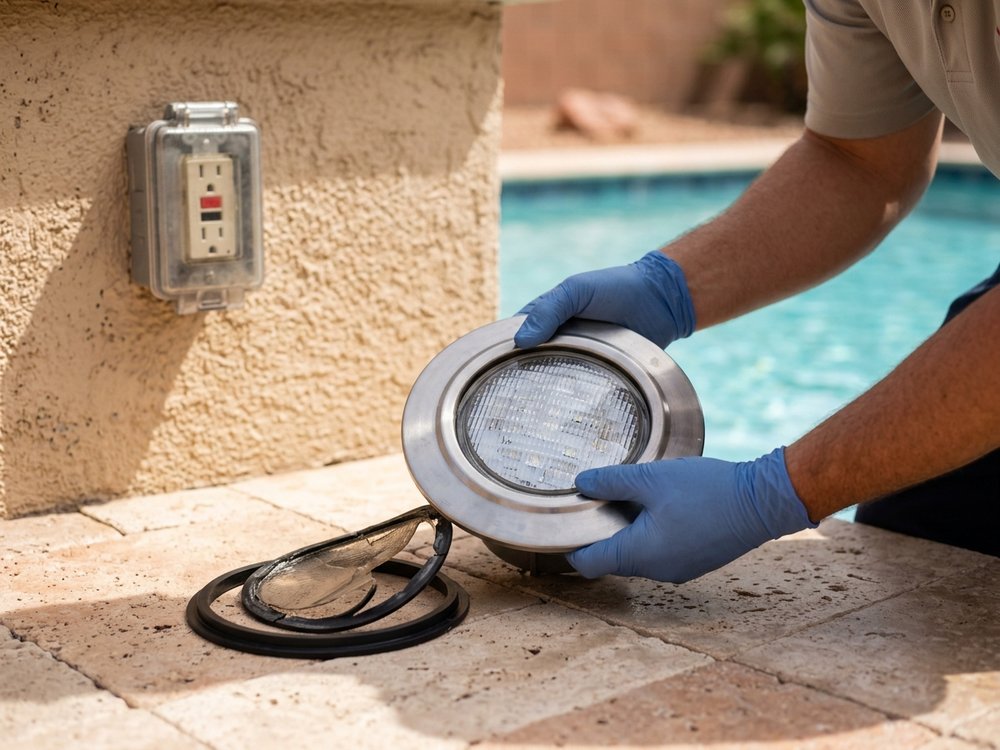
The fixture is only half the job; the seal that keeps water out of it is the other half. Pool lights sit in a niche, and the lens gasket, fixture seal, and conduit all have to be watertight or moisture works its way into the housing and wiring. A failed seal is a frequent cause of repeat failures and GFCI trips, because each fix is undone by water creeping back in. When we repair or replace a light, we replace the watertight gasket and confirm the niche and conduit seal correctly, so the fixture stays dry and the repair actually holds instead of failing again in a few months.
This is the step that separates a lasting repair from a recurring headache, and it is the one most often skipped. A new bulb or fixture dropped into a niche with an old, hardened gasket will work beautifully for a few weeks and then fail again as water finds its way back in, often tripping the GFCI on the way. Las Vegas hard water makes it worse: the same mineral content that scales heaters and cells leaves deposits on lens surfaces and gaskets, and the deposits keep a seal from seating cleanly. So we treat the gasket and the niche seal as part of the repair every time, not an optional extra. A light that is sealed right stays dry, stays safe, and stays lit, instead of becoming the same service call again next season.
Lighting a backyard that gets used at night
Pool lighting carries more weight in Las Vegas than in cooler climates, simply because of when people actually use their pools. For much of the year the daytime is too hot to enjoy the water, and the backyard comes alive in the evening when the air finally cools — which is exactly when the lights need to work. A dead light does not just dim the pool; it shuts down the part of the day the backyard is most usable. That is also why an LED upgrade tends to pay off here: the lights run often and for long stretches, so the efficiency and the long service life of LEDs translate into real savings and far fewer dark-pool service calls. We size and aim the lighting to make the pool genuinely usable after sunset, not just technically lit.
What to expect from a light service
When we come out, we check whether the GFCI has tripped, test the circuit and fixture, and inspect the niche and seals so the diagnosis covers the whole system, not just the bulb. You get a clear answer — bulb, fixture, wiring, GFCI, or seal — along with the cost and your options, including an LED upgrade where it makes sense. Once we make the repair, we replace the watertight gasket, confirm the fixture is sealed and the circuit is safe, and verify the light works before we wrap up, so your backyard is ready for use after dark.
If your pool light is dead, flickering, or tripping the breaker, call or text us and we will diagnose it safely and get your nights back.
SERVICE VERIFY: confirm Las Vegas Pool Cleaner offers this exact service (and any equipment/credential it requires) before launch.
AUTHORITY LINK TODO: add one verified outbound source (see references/authority-domains.md) that supports a specific claim on this page, in-paragraph, then set authorityVerified: true.