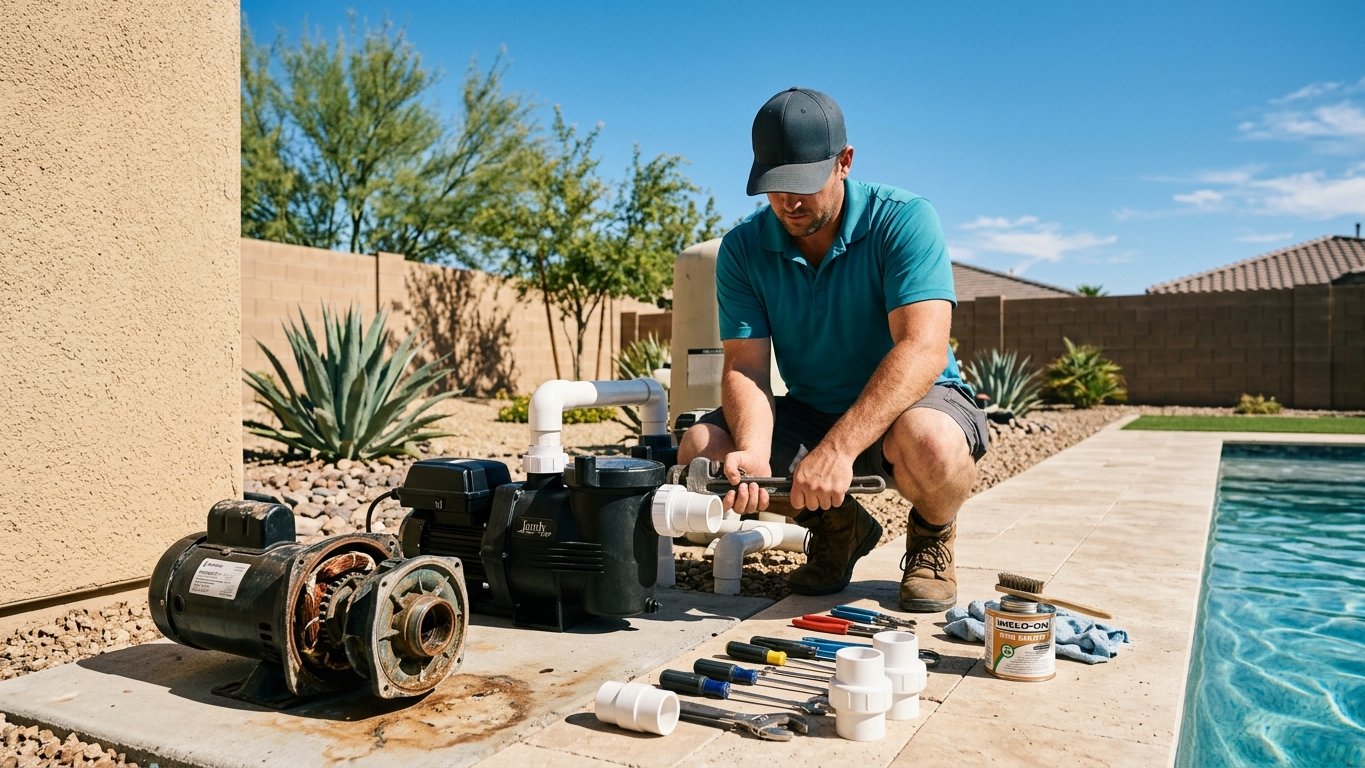
A failed pump is the most common — and most urgent — pool repair we see in Las Vegas. The pump is what moves your water through the filter and sanitizer, so when it stops, the pool stops circulating, and in summer heat the water can turn green within days. Our pump work starts with finding the real cause instead of swapping parts blindly, and it is part of all of our Las Vegas pool repair services.
Common pump failures we diagnose
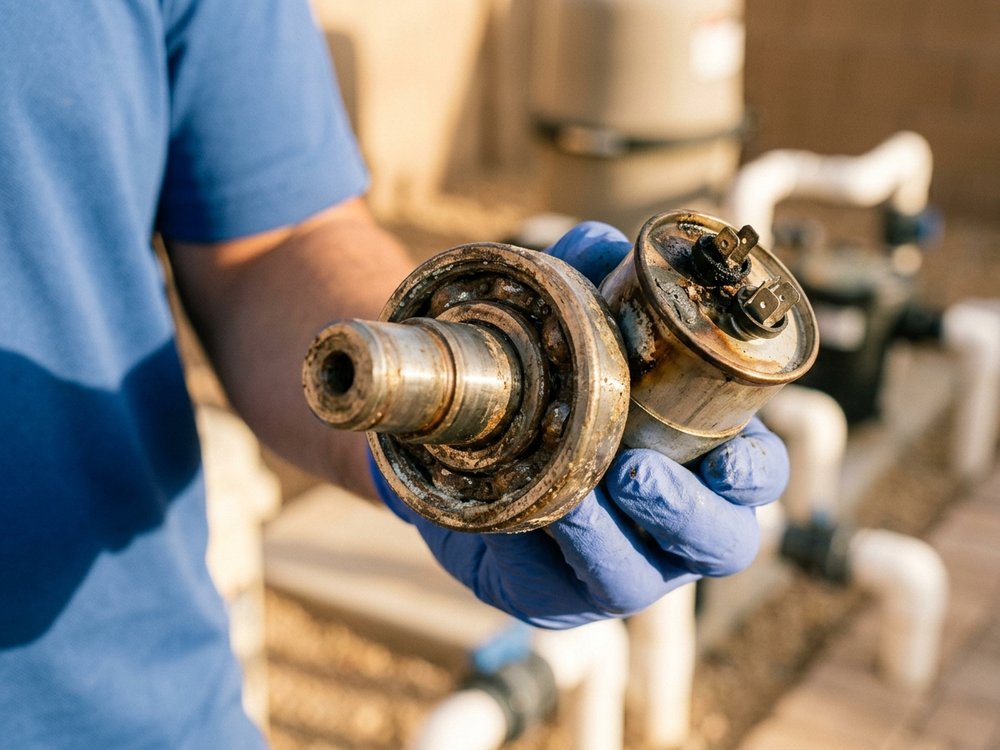
Most pump problems trace back to a handful of parts. A grinding or screeching motor points to worn bearings. A pump that hums but won’t spin, or trips the breaker, usually has a failed start capacitor or a shorted motor winding. A pump that runs but won’t prime is pulling air on the suction side — a cracked lid o-ring, a clogged impeller, or a worn shaft seal. And a wet motor base often means the shaft seal has failed and water is leaking back into the motor. We test for each rather than guessing, because replacing the wrong part is just wasted money.
The reason a careful diagnosis matters so much is that these symptoms overlap. A pump that won’t start could be a capacitor, a seized bearing, a tripped GFCI, or a motor that has finally given up — and each points to a different repair and a very different cost. Swapping in a new capacitor on a motor whose bearings have already welded themselves solid just delays the real fix and adds a part you did not need. So we test the electrical side, spin the motor by hand, and check the suction and discharge plumbing before we tell you what is wrong. When we name a part, it is because we confirmed it, not because it was the cheapest guess.
No prime and airlock problems
A pump that loses its prime is one of the most frustrating issues for owners, partly because the cause is usually invisible. The pot empties, the pump spins dry, and the water stops moving. In nearly every case it is an air leak on the suction side: a dried-out pump lid gasket, a low pool water level letting the skimmer draw air, or a loose union. Las Vegas evaporation makes the low-water version especially common in summer, when the pool line drops fast and the skimmer starts gulping air. We pressure-check the suction plumbing, reseal what needs it, and confirm the pump holds prime before we leave.
Repair versus replacement: the honest math
Not every pump is worth fixing, and we will tell you when it is not. A newer pump with a failed capacitor or seal is an easy, affordable repair. An older single-speed motor that has burned out is a different decision: the repair might cost nearly as much as a better pump, and you would be putting money into an inefficient unit. Because Las Vegas pumps run such long hours, the energy difference between an old single-speed and a modern variable-speed motor is large — ENERGY STAR notes that halving a pump’s speed cuts its energy use to roughly one-eighth. We lay out the repair cost next to the replacement cost — including what a variable-speed pump would likely save you each month — so the choice is yours, not ours.
Why Las Vegas is hard on pumps
Desert conditions wear pumps out faster than almost any climate. To keep water clear in triple-digit heat, pumps here run long daily cycles, and all those hours add up on bearings, seals, and motor windings. Direct sun beats down on equipment pads, pushing motor temperatures higher. And the valley’s hard water leaves scale and mineral buildup that can stress the impeller and plumbing over time. A pump that might last a decade in a mild coastal climate often works much harder here, which is exactly why we see so many of them and why preventing small issues from escalating matters.
The run hours are the heart of it. A pool has to turn its entire volume over often enough to keep chlorine distributed and debris moving to the filter, and in 110-degree summer heat that means many hours of pumping every day, every day for months. A motor that spins eight to twelve hours a day through a long cooling season simply accumulates wear faster than one that runs a few hours in a mild climate. Add the afternoon sun cooking the equipment pad and the hard-water scale slowly narrowing the plumbing, and the pump is fighting on three fronts at once. None of that is a reason to fear pump ownership — it is just why a small noise or a brief loss of prime is worth addressing early here, before the extra load turns a cheap part into a dead motor.
Sizing and setting up a replacement
When a replacement is the right call, getting the new pump sized and configured correctly matters as much as the install. A pump that is too powerful for your plumbing wastes energy and can strain the filter and pipes; one that is too weak won’t turn the water over in the time a desert pool needs. We match the new pump to your plumbing, filter, and pool volume, and with a variable-speed unit we program a run schedule that keeps the water clear while spending as little electricity as possible — typically a long, slow turnover that does the job for a fraction of the cost of an old single-speed running flat out. A correctly sized and well-programmed pump is the difference between a replacement you forget about and one that nags you with high bills or cloudy water.
What to expect when we service your pump
We start by listening to and inspecting the pump while it runs, then test the electrical components, seals, and suction side to pinpoint the failure. You get a straight answer on what broke, whether it is worth repairing, and a realistic timeline — common motors, capacitors, and seals move quickly, while certain proprietary pumps can take longer to source. If a replacement is the better call, we size the new pump correctly for your plumbing and pool, set up an efficient run schedule, and make sure it is primed and circulating before we consider the job done. Because we also handle ongoing service, we can keep an eye on the new pump over time so a fresh seal or bearing issue gets caught early rather than after the motor is gone.
If your pump is screaming, dead, or losing prime, call or text us and we will diagnose it and give you honest repair-versus-replace numbers.
SERVICE VERIFY: confirm Las Vegas Pool Cleaner offers this exact service (and any equipment/credential it requires) before launch.