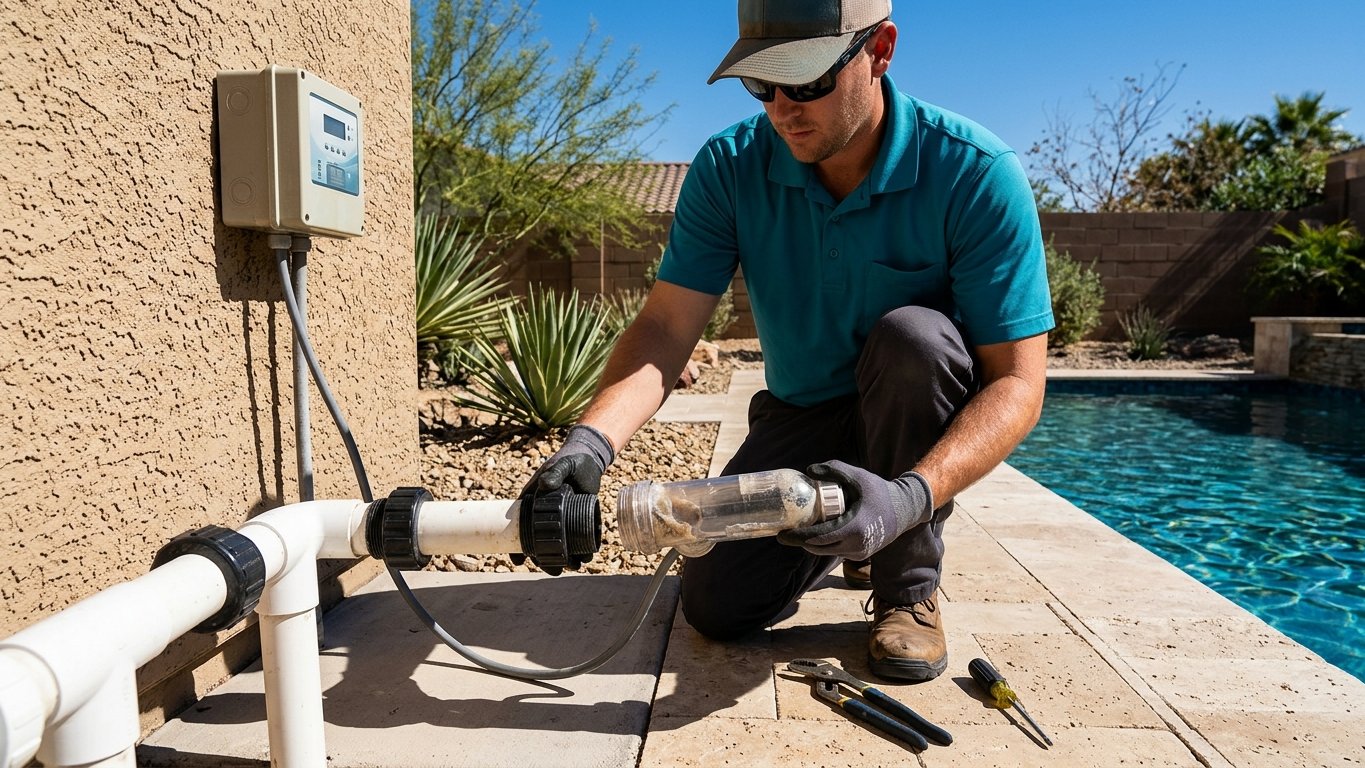
Saltwater pools are popular across the Las Vegas Valley because they make their own chlorine and feel gentler on skin and eyes — but the cell that does the work is a wear part, and the valley’s hard water is hard on it. When a salt system stops producing chlorine, the pool starts losing its sanitizer and can slide toward green fast. Diagnosing and fixing those systems is part of our full range of pool repairs.
Why your salt system stopped making chlorine
When a salt pool stops sanitizing, the cause is almost always one of three things. The most common is a scaled or worn cell: hard-water calcium coats the plates and blocks them from generating chlorine, or the plate coating simply wears out with age. The second is a control-board failure, where the unit powers up but can’t drive the cell correctly. The third is a flow or salinity sensor fault, where the system misreads conditions and shuts production down as a safety measure. We test the cell’s actual output and check the board and sensors to pin down which one it is.
There is an order to how these problems usually reveal themselves, and it is worth understanding because it shapes the fix. A salt cell generates chlorine by passing current through saltwater across coated metal plates, so anything that interferes with that current — scale bridging the plates, a worn coating, a low salt level, or a sensor that has stopped reading correctly — shows up as weak or absent chlorine. Often the pool tells you something is off before the system does: the chlorine drifts down, the water starts to look dull, and only then does the controller throw a code or the cell light change. Because the same end symptom can come from the cell, the electronics, or the chemistry, testing the actual output is the only honest way to know which one to chase, rather than reflexively buying a new cell.
Cleaning, repairing, and replacing the cell
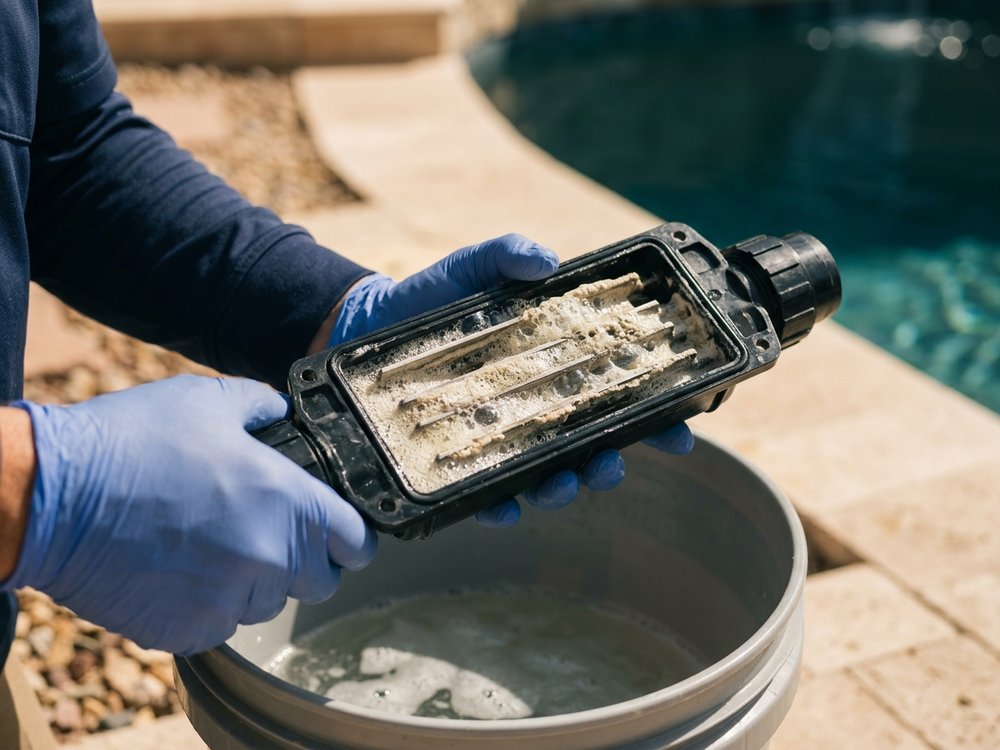
A salt cell that has stopped producing is not automatically dead. Very often it is just scaled, and once we clean the calcium off the plates, output returns to normal — a routine outcome with Las Vegas water. So we clean and test first. If a properly cleaned cell still won’t produce chlorine, or the plates are visibly worn, pitted, or flaking, the cell has reached the end of its life and we replace it. We will not sell you a new cell when a cleaning would have fixed it, and we will not keep nursing a cell that is genuinely spent.
Control boards, flow sensors, and wiring
Not every salt-system problem is the cell. The control board is the brain of the chlorinator, and when it fails the system may show error codes, lose its display, or stop driving the cell even though the cell is fine. Flow sensors and salinity sensors can foul or fail and make the system think there is no flow or the wrong salt level, shutting production down. We diagnose the electronics and sensors alongside the cell so we are treating the real fault — replacing a perfectly good cell does nothing if the board or a sensor is the actual problem.
How hard water scales the plates
Las Vegas hard water is the defining challenge for salt systems here. The valley’s tap water carries a heavy calcium load, and the inside of a salt cell is exactly where that calcium likes to deposit. As scale builds on the plates, it physically blocks chlorine generation, which is why scaled cells are the number-one reason salt pools here stop sanitizing. That same mineral buildup can foul the flow sensor and forces more frequent cell cleanings, each of which slightly wears the plate coating over time. Keeping calcium hardness in range is the single best thing you can do to extend a cell’s life, and we look at chemistry when a cell keeps scaling up.
There is also a quiet irony built into salt systems that makes scale worse here. As the cell generates chlorine, the chemical reaction at the plates raises the pH right at their surface, which encourages calcium to drop out of solution exactly where you least want it — on the plates themselves. In soft water that effect is minor; in Las Vegas water already loaded with calcium, it accelerates the scaling that kills cells. That is why a salt pool in the valley needs its calcium hardness and pH watched more closely than the same pool would somewhere with gentler water, and why we treat a cell that scales up again and again as a chemistry symptom to solve, not just a part to keep cleaning. Fix the water and the cell lasts; ignore it and you are buying cells on repeat.
Keeping a repaired salt system healthy
Getting a salt system producing again is only worth it if the fix holds, and in this climate that depends on what happens after we leave. A cleaned or replaced cell handed back to water that is still out of balance will simply scale up and fail again, so we treat the chemistry as part of the repair, not an afterthought. We check that salinity sits in the cell’s target range, that calcium hardness and pH are controlled, and that the cell is set to a sensible output for your pool and run schedule rather than working flat out. With ongoing service we can keep those numbers in range week to week, which is the real secret to long cell life in Las Vegas — most cells here die early not because they were bad, but because the water around them was never managed.
What to expect from a salt-system service
When we come out, we test the cell’s output, inspect the plates for scale and wear, and check the control board and sensors so the diagnosis is complete rather than a guess. You get a clear answer — clean the cell, replace the cell, or repair the electronics — with the cost and a realistic timeline, since common cells and boards are usually quick to source while some proprietary units take longer. Once it is repaired, we confirm the system is generating chlorine and reading salinity correctly, and we will flag any chemistry issue that is shortening your cell’s life so the fix actually lasts.
If your saltwater pool has stopped making chlorine, call or text us and we will find out whether it needs a cleaning, a new cell, or an electronics repair.
SERVICE VERIFY: confirm Las Vegas Pool Cleaner offers this exact service (and any equipment/credential it requires) before launch.
AUTHORITY LINK TODO: add one verified outbound source (see references/authority-domains.md) that supports a specific claim on this page, in-paragraph, then set authorityVerified: true.