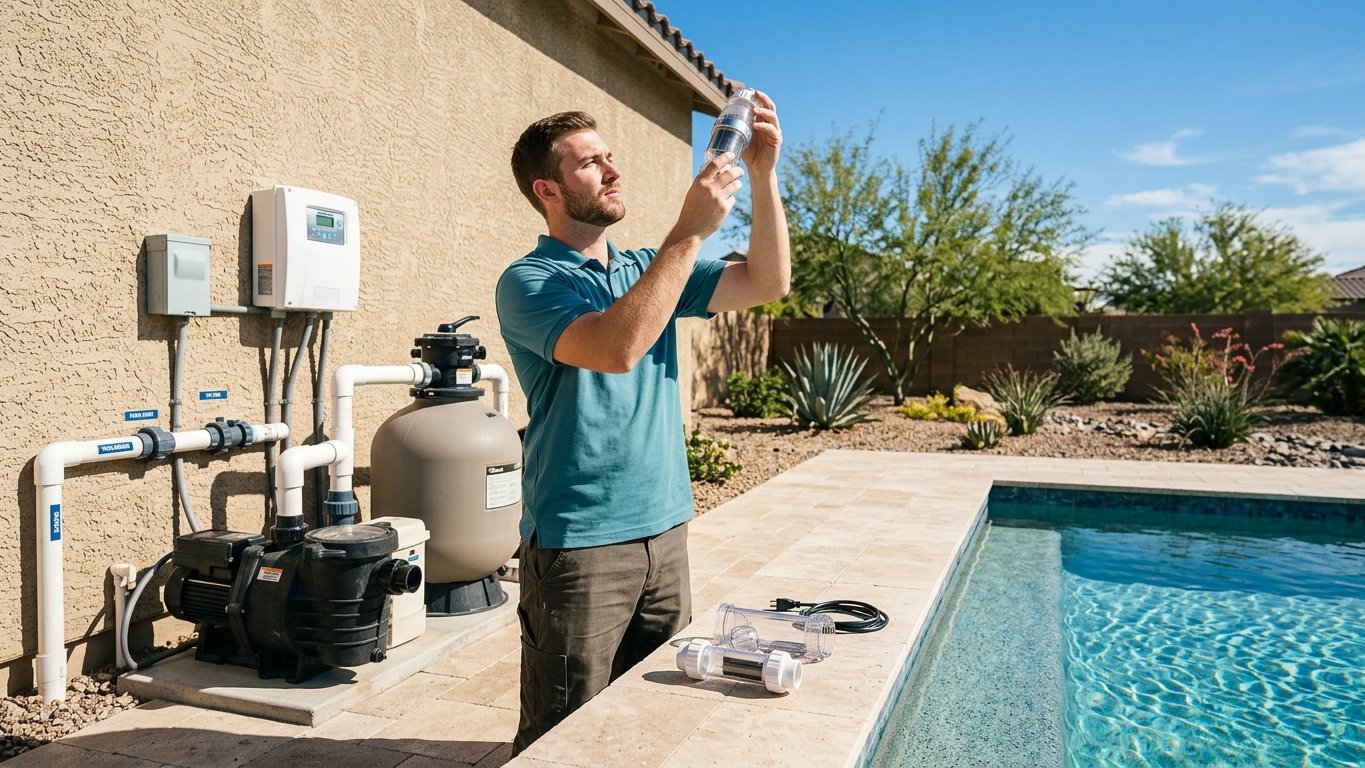
A saltwater pool is wonderfully easy to swim in — softer water, no jugs of chlorine to handle — but easy to swim in is not the same as nothing to maintain. The salt cell makes your chlorine, yet everything else about pool care still applies, and in Las Vegas the hard water adds a wrinkle that catches a lot of salt-pool owners off guard. Saltwater pools fit naturally into our scheduled weekly pool service, with the routine simply tuned to how a salt system actually behaves.
What a salt system does and does not do
The most useful thing to understand about a saltwater pool is the division of labor. The salt cell converts dissolved salt into chlorine as water passes through it, so you are not adding chlorine by hand — that part really is easier. But the generator does not touch pH, total alkalinity, calcium hardness, or stabilizer, and those still move around constantly, especially under the Las Vegas sun. In fact salt systems tend to push pH upward on their own, which has to be managed. So a salt pool still needs the full chemistry routine; it has simply automated one piece of it. Treating a salt pool as maintenance-free is the mistake that leads to cloudy water and a scaled-up cell.
Why hard water is tough on salt cells
This is where Las Vegas changes the equation. The valley’s water is very hard, and salt generators naturally raise pH as they run — and higher pH plus abundant calcium is exactly the condition that drives scale onto the cell’s plates. As calcium builds up on the cell, it produces chlorine less and less efficiently, and a pool that was holding fine can start to drift as the cell quietly loses output. In a soft-water region a cell might go a long while between attention; in the desert it scales faster and needs a closer eye. Keeping pH in check and catching scale early is a real part of running a salt pool here, not an afterthought.
What we do on a saltwater service visit
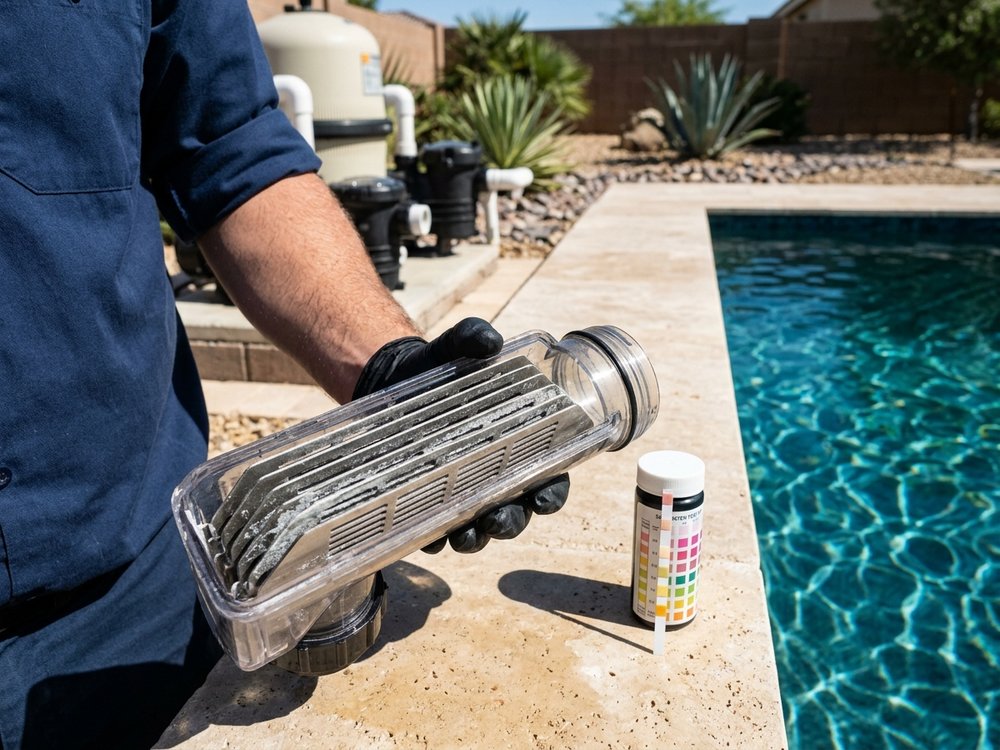
Every visit starts with the same thorough routine any pool gets — skimming, brushing the walls and steps, vacuuming or checking the cleaner, emptying the skimmer and pump baskets, and looking over the equipment. Then we add the salt-specific work. We inspect the cell for scaling and wear, since a scaled cell is the most common reason a salt pool starts to slip. We check the salt level, because too little salt means the generator cannot make enough chlorine, and we confirm the system is reading and running correctly. Finally we test and balance the water by hand — pH, alkalinity, calcium hardness, and stabilizer — because the generator only owns the chlorine. You get a chemistry note showing exactly where it all stood.
Keeping the chemistry honest
The temptation with a salt pool is to assume the automation has it covered, but the desert does not allow that. Heavy summer evaporation concentrates minerals and drops the water line, intense UV burns through stabilizer, and the generator’s upward push on pH compounds the hard-water scaling problem. Left unattended, those forces add up to a cell crusted with calcium and chemistry quietly out of range even though chlorine is technically being produced. Staying on top of pH and the full balance is what keeps the cell efficient and the water clear, and it is the part of salt-pool ownership that most benefits from a regular set of eyes on it.
Service, not guesswork on repairs
This is maintenance and care rather than cell or generator repair, and we are clear about that line. We keep the salt level right, the chemistry balanced, and the cell watched, which is what keeps the whole system doing its job. When we do find a cell that is heavily scaled, worn, or near the end of its life, or a generator that is not operating the way it should, we tell you plainly what we found and what it will take, so you can plan a replacement or repair on your terms instead of discovering it during a summer heat wave.
Want your saltwater pool handled by someone who knows how salt systems behave in this water? Call or text for a quote.
SERVICE VERIFY: confirm Las Vegas Pool Cleaner offers this exact service (and any equipment/credential it requires) before launch.
AUTHORITY LINK TODO: add one verified outbound source (see references/authority-domains.md) that supports a specific claim on this page, in-paragraph, then set authorityVerified: true.